Heathcliff's mysterious origins
Wuthering HeightsHeathcliff's origins are the novel's founding enigma, a void at the center of Wuthering Heights that shapes his entire existence and the fates of everyone around him. He appears without a past, a foundling whose unknown parentage, birthplace, and even his initial acquisition of wealth remain unexplained throughout the narrative. This indeterminacy is not a mere plot device but the very source of his identity as an outsider, marking him as a permanent stranger in the closed, hierarchical society of the Yorkshire moors and fueling the resentments, loves, and vengeances that constitute the novel's drama.
The Foundling of Liverpool
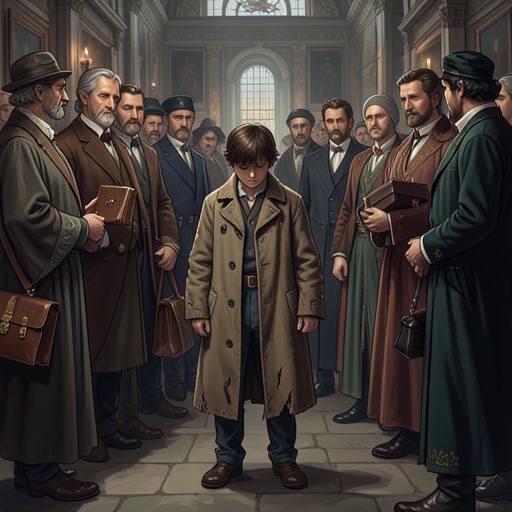
The only concrete fact of Heathcliff's origin is the manner of his discovery. Mr. Earnshaw, the elder master of Wuthering Heights, on a business trip to Liverpool, found the child 'starving, and houseless, and as good as dumb' in the city's streets. He was a 'dirty, ragged, black-haired child,' big enough to walk and talk, yet his speech was an incomprehensible 'gibberish' that nobody could understand. Mr. Earnshaw, determined not to leave the child as he found him, brought him home, a decision that would prove catastrophic for his own family. The journey itself was ruinous: the master returned 'nearly killed' from the walk, and the presents he had promised his own children were destroyed in the effort to carry the foundling—Hindley's fiddle was crushed to morsels, and Catherine's whip was lost. The child's arrival was met with immediate hostility from Mrs. Earnshaw, who was ready to fling the 'gipsy brat' out of doors, and from the servants, one of whom, Ellen Dean, put him on the landing of the stairs hoping he would be gone by morning. Only the master's intervention, finding the child crept to his door, saved him from this initial neglect.
A Name Without a Past
Upon his arrival, the child was christened 'Heathcliff,' a name that served him 'both for Christian and surname.' This name was not his own but the name of an Earnshaw son who had died in childhood, a borrowed identity that underscores his lack of any intrinsic one. The mystery of his true origins is a subject of speculation and prejudice. Mr. Linton, the elder, upon seeing him, dismisses him as 'that strange acquisition my late neighbour made, in his journey to Liverpool—a little Lascar, or an American or Spanish castaway.' The Lintons' language reveals the racialized lens through which he is viewed: he is a 'gipsy,' a 'Lascar,' a 'castaway,' an exotic and inferior being. Ellen Dean, in a moment of kindness, tries to console the young Heathcliff by inventing a romantic lineage for him, suggesting his father might have been the 'Emperor of China' and his mother an 'Indian queen,' and that he was 'kidnapped by wicked sailors and brought to England.' This fantasy, however, only highlights the painful reality: his origins are so unknown that any story, no matter how outlandish, is as plausible as another. Even at the end of his life, the mystery remains. Ellen Dean, reflecting on his death, muses on his origins, asking, 'But where did he come from, the little dark thing, harboured by a good man to his bane?' The answer is never given. His headstone in the kirkyard bears only the single word 'Heathcliff' and the date of his death, as there was no surname and no age to record.
The Mark of the Outsider
The mystery of his origins is inseparable from his physical appearance, which marks him as an outsider from the moment he is introduced. Ellen Dean's first impression is of a 'dirty, ragged, black-haired child' whose face looked older than Catherine's. As an adult, Mr. Lockwood, the novel's initial narrator, describes him as 'a dark-skinned gipsy in aspect, in dress and manners a gentleman.' This contrast between his dark, foreign appearance and his gentlemanly bearing is a source of constant tension. The Lintons, representatives of the refined, civilized world of Thrushcross Grange, are shocked that Catherine Earnshaw would 'scour the country with a gipsy,' and they deem Heathcliff 'quite unfit for a decent house.' This racialized otherness is the foundation of Hindley's hatred. From the very beginning, Hindley views Heathcliff as a 'usurper of his parent's affections and his privileges,' and after Mr. Earnshaw's death, he degrades him to the status of a servant, denying him the education and position that his own birthright would have conferred. Heathcliff's dark complexion and unknown origins thus become a justification for his systematic mistreatment, a social stigma that he internalizes and ultimately weaponizes.
The Mystery's Enduring Power
The unresolved nature of Heathcliff's origins is not a flaw but a central element of the novel's power. It allows him to be a figure of almost mythic proportions, a 'cuckoo's' child, as Ellen Dean calls him, who is 'cast out like an unfledged dunnock.' His lack of a defined past makes him a blank slate onto which the fears and prejudices of others can be projected. For the Earnshaws, he is a gipsy brat; for the Lintons, a Lascar castaway; for Ellen Dean, a potential prince in disguise. This indeterminacy also fuels his own monomaniacal drive. His revenge is not just against Hindley or Edgar Linton but against a world that has defined him by his origins and denied him a place within it. His mysterious wealth, acquired during his three-year disappearance, is another facet of this enigma, a power that he wields without explanation. In the end, the mystery of Heathcliff's origins remains as impenetrable as the man himself. He dies as he lived, an enigma, and his grave, marked only by his single, borrowed name, stands as a final testament to the void from which he came and the impossibility of ever filling it.